Friday, January 6, 2012

Housing for the Livestock

On the left is my first constructed bee hive. Cat Dancing painted it with some help from Michael, now the ladies have moved in and made themselves at home. We got the bees a short time ago, after they weathered a fiercely hot summer. We already have plans to build more hives to sell, as well as working on a hive cooperative plan for area growers. I'll post more as it develops.


Previously I posted about our new chickens. They are all doing well, and the "rescues" I added to the flock have come along nicely as well. We've got daily eggs for breakfast and baking. 


This is the temporary coop that came with the chickens. It's barely adequate for the number of hens we have, plus, it is a bit reminiscent of the legendary "two story outhouse". Particularly for the hens on the bottom roost! Therefore, my current project is to build a new hen house!
For awhile I've been admiring pictures of what is called an "Amish" style hen house. It's a very compact and sensible design. I worked up my own plans for one and got to work.


The main frame verticals are tied directly to the skids. I used treated 4x4 lumber, notched and bolted at the base. So far this is the only purchased lumber to go into this project. Two skids are required.


The artisan at work. Ahem! 


Once the skids are done, the framing begins. Here the floor platform and the back wall is started. The footprint is essentially 5'x6'. The rest of the building is made from scavenged material. 


We had a nice piece of 3/4 plywood from an old bed frame we rescued from someone's trash. It was almost large enough for the floor. I added a pair of scavenged 1x12s to finish the floor out. 

Here the wall framing is nearly done. It is ready for the roof  joists. It is taking shape. You can perhaps make out the large doorway in the near end, and the chicken door at the far end. Also, the nest box area is visible. The sloping part on the right side will be the hinged lid to the nest boxes.


More to come!

Monday, November 21, 2011

How It Happens.

We hosted a bit of a party at EarthSong Retreat last night. It was our first since we moved here, and it was a bit of a house-warming as well. Friends brought goodies to swap, I gave a tour of the property and related our permaculture -type plans for it, we had a taco feast and a drum jam.


The friends who attended came from several diverse avenues of our interests; pagan, Tarot students, Avatar, Sherwood Forest friends, even a lady friend of mine from some time back.


At one point, after the tour and tacos, said friend pulled me aside and asked me, "How can you afford all this?"


You see, she knows a lot of my history, as well as the fact that monetary riches and my name do not normally go in the same sentence. However, here I am, living on a very pretty six acre property with a nice house, my own office trailer, a workshop/studio for Cat and myself, and plans for orchards, gray water systems, and so on.


She seemed to think we own the place. (Apparently she missed the part on the tour where I introduced our landlady!) I gave her a very shortened version of how it happened, she thought it a bit inspiring for her own reasons. I was thinking about writing her an email with the expanded version to clarify things.
And then I thought, hey, why not make it a blog? After all, I've posted several of the related issues here before, but I never really tied it all together in one post.


Flashback:
Cat Dancing and I met in 2007 and instantly knew we belong together. I moved in, and we immediately were dreaming of finding another place where we would have more freedom to make some of our mutual dreams come true. We hoped for enough space to have a retreat center, a place for making art and writing, for teaching classes, and to host our friends. A few things presented themselves, but didn't work out.


In 2009 I took my first Permaculture Design Course in Austin. I was blown away by it. All my life I've been interested in so many subjects that make up what we can now refer to as sustainable, even self-sufficient living. I was a long time believer in organic gardening, long time reader of The Mother Earth News, practicing what I had learned in various ways. Suddenly, here was Permaculture, tying it all together, showing me how all these things relate to each other. This became a model for how I wanted to support myself. We renewed our search for "our place" to carry out these principles.


At about the same time, Cat became interested in "Avatar", soon bringing me into it as well. Not the wonderful movie, but the wonderful self discovery course by Harry Palmer. We both became Masters, and Cat has gone on to become a Wizard.


It is not doing the course justice to simplify it in this way, but one of the many effects is to sharpen the will and focus the mind on what you need in your life and erasing negativity around those needs. (Take it from me, there is a lot more than that to it. All of Avatar is well worth looking into.) Anyway, we learned how to constructively desire our new place.


We also became active in bartering. Cat has long traded art and tarot readings for other goods and services at events and shows. We also joined the Austin Time Exchange, a clearing house for bartering time units. Really cool. If you are a webmaster, for instance, you can do a website for someone who gives you however many hours credit on the exchange you agree on, then you may exchange that credit for, say, an equivalent amount of work from a participating auto mechanic, or masseuse, or whatever.

Money is NOT the only economy out there! Barter is alive, as is time exchange and even gift economy
By the way, as I've posted before here, we are active Freecyclers. Our workshop and office trailer were freebies, free for the hauling, not really through Freecycle, but because I was paying attention and celebrating the concept. 

Freecycle would be an example, I believe, of the gift economy mentioned above. Instead of taking usable things to the dump, or even a thrift shop, I post online that I have it. Someone who wants it gets in touch. Likewise, if I need something, I post that need, someone else possibly has it and would like to get rid of it. "One man's trash is another's treasure", etc. No money changes hands, only usable goods.


All this goes to illustrate our mind-set when it finally happened! Another interest of ours has been "intentional communities". We learned of a meeting of one such, Vajra Azaya, taking place in Austin. While there, we fell into conversation with a new friend, who told us of her new property, six acres near Lake Bastrop. She had plans to retire there in five years and hoped to find a renter who would be able to make needed repairs, as well as someone who could carry out a Permaculture plan on the property.


We went to see the place and quickly volunteered! We offered to exchange my Permaculture services, as well as our "fix-it" know how for partial rent on the place. With that exchange in place, we pay no more rent than we did at our previous house, we have much more freedom to "do our thing", and it is much more convenient to everything we do in Austin and elsewhere. In actuality, since it is a "real" house and much more efficiently built, we pay less overall per month due to savings in utilities, etc. (The previous rental was an un-skirted, unshaded mobile home, although a nice one.)


Another factor that makes it work; the landlady and we are totally in agreement on plans for the space here. It's a win-win for us both.


I'm not sure any one of the above factors can be considered the major factor in this project. They all play a part. Avatar and barter for mind-set, Permaculture and skill set for inspiration, partnership and friends for opportunity, it was all there. 


On the other hand, there is a quote attributed to Seneca. Luck is what happens when preparation meets opportunity.

So that's how we "afford it". Now we just have to "do it!" Stick around and watch it happen!

Friday, November 11, 2011

Austin Celtic Festival 2011

Cat Dancing Creations set up a booth at the Austin Celtic Festival last weekend. There were a lot of people out both days for the music and events. Business was only so - so. We had plenty of lookers, but not too many people seemed to be buying anything. Cat finally put out her Tarot Reading sign on Sunday and that brought in enough money to make it almost worthwhile.
The music was great, though. I particularly enjoyed Ed Miller and The Silver Thistle pipe band. 
It was cloudy and windy all weekend.
In the pic above you can see our booth.


As well as a really alert young man behind my right elbow.
Not mentioning any names.


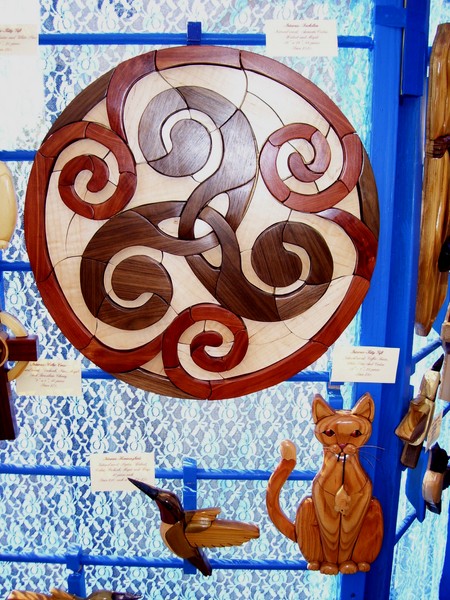
One of our new pieces we featured for the Celtic Festival. 
A triskelion from three woods. It's a new design and pretty cool!


This weekend we're setting up at the Vortex Theater on Manor Rd. in Austin for the East Austin Studio Tour. See you there!

Sunday, October 30, 2011

Inaugural Sherwood Forest Celtic Festival and Highland Games

A few weeks back we had the first annual Celtic Festival at Sherwood Forest. What a great time! The folks at Sherwood Forest Faire decided to have this Celtic festival to fill in a bit of the off season. Our third season of the actual Renaissance Festival starts next February 11, 2012 and runs through April 1. I'll be posting more, no doubt about it. You can also see pictures posted in my past blogs here.


We had many people coming through who were there for the first time. I'm afraid a few were disappointed. It did look a bit underwhelming. I mean, the grounds are great, but only a few of the usual vendors set up for this one weekend event. Many are busy at other faires or getting ready for the Texas Renaissance Festival starting soon.


Everyone was surprised by the turnout. I don't have the final numbers, but there were already 3,000 people there by 2 pm on Saturday. The food and drink vendors were running out of supplies already by then. Cat Dancing Creations, our booth #309, had our best sales day ever.

Tuesday, October 25, 2011

Upcoming Permaculture Classes in Austin!

Classes are currently forming for two upcoming Permaculture Design Certificate courses in Spring of 2012. Sign up now, they fill fast!


2 Upcoming classes:

Spring Weekend Permaculture Design Course with Dick Pierce.
Held in Austin, Tx. Location to be announced. 10 Saturdays- Jan. 28 - Apr 7.
The cost of this Permaculture course is $600.
Reserve your space now with a NON-REFUNDABLE deposit of $120. The deposit can be paid to your registrar, William Seward,  (512) 468-7835 (raincrow_permaculture@yahoo.com ) or see the PayPal button in the sidebar. Be sure to indicate which class you are registering for, and include your name, email, and phone number.
The balance of $480 is to  be paid to Dick Pierce on or before the first day of class.

Winter/Spring 2012 Saturdays Course dates and topics:
Jan 28: Basics 1
Feb 4:
Basics 2
Feb 11:
Soil & Water
Feb 18:
Building & Energy
Feb 25:
Urban Permaculture; Gardens
Mar 3:
Design Basics
Mar 17:
Rural - Farm & Ranch NOTE: no class Mar 10)
Mar 24:
Design Workshop
Mar 31:
Design Workshop
Apr 7:
Design Presentations/Wrap-Up
Date & Location TBD: Graduation Potluck & Celebration
This course includes classroom instruction, hands-on projects (including your site design project), presentations by guest instructors, and field trips. 

ABOUT THE INSTRUCTOR:
Dick Pierce
is a permaculture teacher and designer with many years of experience in central Texas and New England. He has studied permaculture design with Bill Mollison, Geoff Lawton, and Patricia Allison. Dick’s experience includes working on farms, working with Native American tribes across the US, and running a greenbuilding program for young people at American Youthworks, a nonprofit high school in Austin. He also helped launch the popular “Citizen Gardener” program, aimed at promoting food self-sufficiency in Austin through gardening. Dick was born and raised in New England but has called Central Texas home for over a decade.

Spring Intensive Permaculture Design Course with Kirby Fry.
This two week intensive course will begin at 9am, on Saturday, April 21, 2012 and conclude at 5pm, Friday, May 4, 2012.  It will be held about 40 miles east of Austin, at 1483 CR 311, McDade, Texas 78650.  There will be some camping/overnight space available (please let us know, in advance, so that we can make sure we are able to accommodate you).  Basic meals will be provided daily (bringing something extra to contribute to the group is encouraged, but not required).
The cost of this Permaculture Intensive is $600. Reserve your space now with a NON-REFUNDABLE deposit of $120. The deposit can be paid to William Seward,  (512) 468-7835. (raincrow_permaculture@yahoo.com ) Or, use the PayPal button on the sidebar of this blog. Be sure to indicate which class you are registering for, and include your name, email, and phone number.

The balance of $480 to be paid to Kirby Fry on the first day of class.


CURRICULUM As taught by Kirby Fry (see bio, below):
Day 1 (April 21, 2012): Introduction of teachers and students, definitions of Permaculture and sustainability, state of the world, ethics, principles, zones, sector analysis.
Day 2 (April 22, 2012/Earth Day): The function of design, methodologies of design, patterns, observation exercise, the soil food web, the function of forests, the function of prairies.
Day 3 (April 23, 2012): Annual gardening, perennial gardening, food forests.
Day 4 (April 24, 2012): The bio-regions of Texas, ecological restoration.
Day 5 (April 25, 2012): Grazing systems, introduction to design projects.
Day 6 (April 26, 2012): Earthworks, aquaculture, aquaponics.
Day 7 (April 27, 2012): Design strategies for Central Texas prairies.
Day 8 (April 28, 2012): Tour / Work Day.
Day 9 (April 29, 2012): Day of rest.
Day 10 (April 30, 2012): Green building, natural building.
Day 11 (May 1, 2012/May Day): Rain water harvesting, grey and black water harvesting.
Day 12 (May 2, 2012): Strategies for sustainable job creation and local activism, in class design project time
Day 13 (May 3, 2012): Invisible Structures, career opportunities, in class design project time.
Day 14 (May 4, 2012): Design presentations, Permaculture design course certificates awarded.

Teacher Bio: Kirby Fry studied conventional agriculture and forestry at Texas A&M and has nearly 20 years of expertise behind him in the fields of natural building, rainwater collection systems, and passive solar cooling systems, among other things.  He studied with Bill Mollison (co-founder of Permaculture) and Scott Pitman (founder of The Permaculture Institute in Santa Fe, New Mexico).


Citizen Gardener
Not a class by the Austin Permaculture Guild, but brought to you by the Sustanable Food Center and taught by Dick Pierce. (See above for bio.)
Austin Spring planting. Learn what you need to go home and DO IT- locate, build, plant, harvest.
Hands-on classes over two Saturday mornings and one Wednesday evening. Mid Jan - March.)


Here are the links for further information.

Austin Permaculture Guild website  (classes, news, other vital information, more links)
http://www.austinperm.com/

The Austin Permaculture Guild group on Yahoo!   (discussion, conversation, what's happening.)
austinperm-subscribe@yahoogroups.com

Citizen Gardener  (great local class for Austin area gardeners.)
www.sustainablefoodcenter.org

Tuesday, September 20, 2011

Logarithms For The Only Slightly Off

Logarithms and steel.
Remember logarithms? There was a time I used them constantly. If you think a logarithm is something an aborigine might bang out on a fallen tree, you're not getting my drift.

Umm. No.


From Wikipedia:The logarithm of a number is the exponent by which a fixed number, the base, has to be raised to produce that number. For example, the logarithm of 1000 to base 10 is 3, because 1000 is 10 to the power 3: 1000 = 103 = 10 × 10 × 10. More generally, if x = by, then y is the logarithm of x to base b, and is written logb(x), so log10(1000) = 3.
Logarithms were introduced by John Napier in the early 17th century as a means to simplify calculations. They were rapidly adopted by scientists, engineers, and others to perform computations more easily and rapidly, using slide rules and logarithm tables. These devices rely on the fact—important in its own right—that the logarithm of a product is the sum of the logarithms of the factors:

 \log_b(xy) = \log_b (x) + \log_b (y). \,
The present-day notion of logarithms comes from Leonard Euler, who connected them to the exponential function in the 18th century.

Forget all that.


I suppose mathematicians still use them somewhere, but back in the days before portable computers and scientific calculators, logarithms were a necessary tool.

When I started as a draftsman just out of college there were no handy electronic calculators of desktop computers. No one had even conceived of a laptop computer. Mainframe computers were around, actually, but mostly in large businesses. It would be ten years or so before Alamo Steel, the company I worked for, would have access to a mainframe for accounting.

I was a draftsman, fresh out of college. My math skills were, umm, a bit shaky. Sure, I was okay with basic math, and I had geometry licked. In high school I basically taught my geometry class. The math teacher used to duck out of class for a cigarette in the duplicator room after telling me to explain the homework to the rest of the class. I'd had trigonometry in college, although I'm afraid little of it stuck.

I finally learned, though. When I started working on hip and valley beams and stairs and handrails I was using trig constantly.

This means doing higher math while juggling feet, inches and sixteenths of an inch!

Sure , you can convert to decimals to calculate some things, but ultimately you have to convert back since the required outcome of the procedure was to produce drawings for our shop employees to fabricate steel members with. Our shop guys were great guys, I was friends with many, but quite a few barely spoke English, others could not read. They learned to use a steel tape measure, but it was considered a bit much to subject them to more than the most simple measurements to work with.

So, we in the drafting room were called upon to simplify, and especially to do all of the math and conversions in advance.

One of the first calculating tools I worked with was a slide rule. 

This was, by the way, toward the very end of the heyday of the slide rule. Slide rules use logarithms. The beauty of logarithms is to simplify calculations. When you have multiplication, division, and other complicated operations to perform, you only have to use a conversion table to change the factors to their logarithms, then all operations become addition and subtraction problems.

We all learned multiplication tables in school. Those work great for simple whole numbers. If you are working with complex numbers of many decimal places it can be tedious to sit there and multiply or divide the whole thing out the long way. For instance, if you are multiplying two numbers, you use the tables to convert them to their logarithms, add the two logarithms together, then convert the logarithm sum back to real numbers. That's your answer.

Remember, electronic calculators were not available!

A slide rule, or slip stick, manually added and subtracted logarithms. The scale was a logarithmic scale. If you lined it up to multiply two and two, the answer was four. What it was doing was adding the logarithms for the two numbers graphically, and letting you read the answer.

For a while slide rules, well, ruled! A skilled engineer could read one to several decimal places, and do complicated problems all day long.

Other sorts of slide rules appeared. Not really technically slide rules, as they didn't use logarithms as such, but they did match up factors to show pre-calculated answers. They were common for many fields that required quick and practical calculations. My chosen field before drafting was electronics. I made use of, and still own, several cardboard cutout calculators that were this sort of slide rule. Very practical and quick to use. I still use them from time to time. 
Ohmite Capacitor Calculator
 Once in awhile one of the hobbyist magazines would even print a similar one to copy, fold and tape together.
Did I mention useful?


 Anyway:
Eventually my original K&E slide rule, or slip stick, got replaced.
 
For simple adding and subtracting of measurements, we did have electrical adding machines with special keyboards and a paper tape readout. 
Monroe Foot-Inch-Sixteenth Machine
Victor Foot-Inch-Sixteenth Machine

 These were great. Some of us even used mechanical adding devices, known as Addiators, that used a metal stylus. You used the stylus to advance numbers in one direction for adding, the opposite direction for subtracting. With many of them you kept track of sixteenths of an inch manually, literally, by holding up a pinky finger when you had a sixteenth in the number, folding it away when you didn't. A very few of the Addiator models actually handled sixteenths of an inch.
Addiator 
No electricity, but so much more portable! That was important for those of us who, shall we say, labored with side jobs in the same industry?

The engineers in the company often used a specialized adding machine that allowed you to reset the decimal point, to more rapidly work with big numbers. It did require the conversions to be made from feet and inches to decimals, but once those conversions were made, their calculations could be carried out and the answers converted back at the end. 
Shifty Monroe Machine
You actually manually moved the carriage over to the correct decimal place column. Some of these had a little crank below the keyboard to do this! Sure, it was electric, but still, can you say Fred Flintstone?


An integral part of the calculating process was a book. Several of our available books did have the foot-inch-sixteenth to decimals of a foot conversions available, but one book was our math “bible”. 
Smoley's
Smoley's Tables were available either as four separate books, or all four combined into one volume. The fourth volume, Segmental Functions, was useful for circular calculations, critical when needed, but rarely used. The first three volumes had to do with decimal equivalents, squares, logarithms, and trigonometric functions. Those we used constantly. We were each required to obtain our own Smoley's books. When we could, we got the first three together in one volume, and the fourth separately. That fourth Segmental Functions volume would last forever, and did! We could often wear out two or three of the first three volumes before the fourth would even show wear.

Those logarithms and trig functions really came in handy! Perhaps I should also mention that this was in the days of manual drafting as well. Lead pencils, T-squares, triangles, lettering guides, drafting tape, tracing paper. CAD programs did not exist. Dinosaur days. This was in 1971 and years following.

We had to know the mechanics of drawing a pencil line, and construct various shapes to put together a useful drawing, and then to hand print the lettering to explain and dimension everything. Then, copies were made with a smelly ammonia Ozalid process to produce real “blueprints”.
We ended each day with liberal amounts of graphite and rubber eraser dust on ourselves.

TI Calculator
Well, after a few years, Texas Instruments came along with a series of hand held electronic calculators. Now THAT was revolutionary! We still had the conversion problem to deal with, but suddenly it was less of a chore. The so-called “scientific calculators” appeared with more and more functions, including trigonometric functions that made things easier. We were able to rely less and less on the Smoley's tables, and go straight to calculating.
Bigger than a breadbox Wang
About the time that mainframe computers became more accessible and user friendly, programmable calculators appeared. The first were pretty large affairs. The Wang programmable was one we utilized for awhile. Pretty nifty! I actually taught myself to write programs for it! (As a mere draftsman, this was a bit above my station, but I tended to color outside my lines a lot!) Two number pads with memories meant you could perform more than one operation at a time and merge the answers. Also, it sported a cassette tape program storage, so you could record and reload several programs as you needed them! Display screens were still in the future, all usable output was preserved on paper tape printout.

After only a couple of years, those same hand held calculators we were using became programmable as well. First one, then many programs could be stored and used. The Wang was fairly obsolete in no time. It still worked well for some situations, but for everyday calculations the hand helds were the thing.

It was not until the mid '80's that we were able to finally ignore that conversion problem. Development of calculators that actually worked with fractions and inches was ignored until then. The United States was considering going metric for many years but there was a lot of resistance. Most of us dinosaurs didn't really want to learn a new system. 

The manufacturers finally gave in and designed a few calculators that actually worked in feet-inches-sixteenths. This is the one I have now. It has taken the place of every machine/calculator/book that came before.  This is the Jobber 6 by Calculated Industries. It's great! Online versions are even available, so you can use it without taking your hands off the computer keyboard.

That's important, since Computer Aided Drafting also took over from manual drafting. Of course, most of the major CAD programs like Autocad have several calculating functions built right into them, but... remember those aforementioned dinosaurs? 

I still have my board and pencils, too. I might even have my copy of Smoley's around somewhere!

I admit I've gotten a bit rusty on interpolating logarithm tables. On the other hand, it's been awhile since I've detailed steel as well. Still drafting, though, with CAD and my Jobber!


Friday, September 16, 2011

To The Far Blue Mountains!

I don't repost others' blogs often, but Bish really nailed it in this one:

 BISH'S BEAT: FORGOTTEN BOOKS: TO THE FAR BLUE MOUNTAINS!: FORGOTTEN BOOKS: TO THE FAR BLUE MOUNTAINS! LOUIS L’AMOUR About twenty years ago, I read my way through two dozen or more Louis L’Amour ...